

Improv Icks: When the Scene Gives You the Ick and What to Do About It


That sinking feeling in your stomach when your scene partner does something that just... rubs you the wrong way. Not because it's offensive or inappropriate, but because it triggers an internal "ick" response. You know the feeling - it's that visceral recoil that happens when something feels off, even if you can't quite put your finger on why.
This isn't just about personal preferences. In improv, we call these moments "icks" - and they're actually valuable data points, not just annoyances to be ignored or pushed through.
The Improv Ick
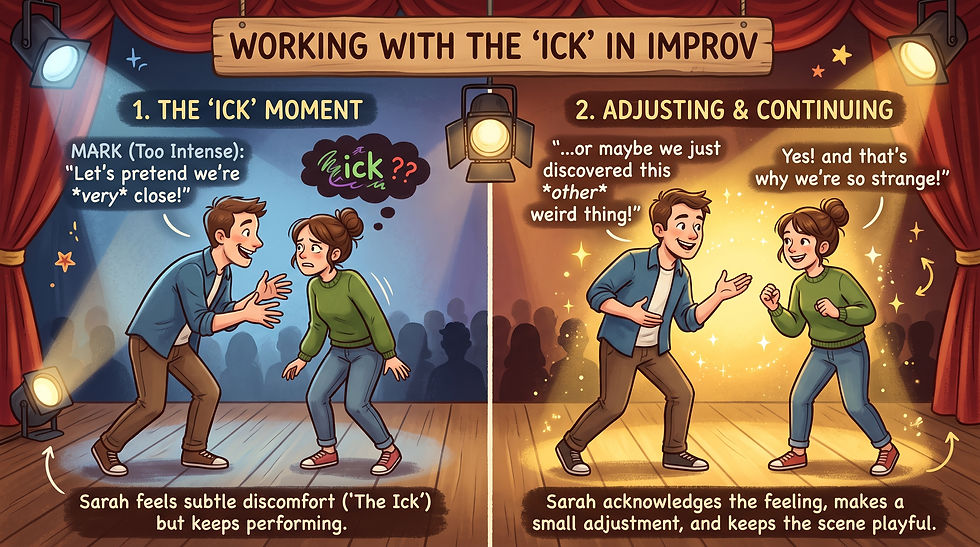
An improv ick isn't about whether something is "wrong" or "bad" by some objective standard. It's about your authentic, in-the-moment reaction to what's happening in the scene. Maybe your partner keeps interrupting you with jokes when you're trying to build a serious moment. Maybe they're too physically close when you need space. Maybe they keep referencing things that pull you out of the reality you're trying to create.
The ick is your intuition speaking up. It's not judgment - it's information.
Why We Ignore the Ick (And Why We Shouldn't)
Our instinct when we feel an ick is often to:
- Push through it ("I'm being too sensitive")
- Blame ourselves ("I should be more flexible")
- Ignore it and hope it goes away
- Or worse, judge our partner for causing it
But in improv, that ick is doing important work. It's telling you about boundaries, about what you need to feel safe to play, about where the scene might need adjustment to work for everyone involved.
When you ignore the ick, you're not being a good sport - you're disconnecting from your own intuition and your scene partner's ability to connect with you authentically.
The Real-World Ick Radar
This same principle shows up everywhere outside the improv theater:
In meetings: That ick when someone keeps talking over you, not because they're trying to be rude, but because their communication style clashes with your need to be heard. The ick isn't about them being wrong - it's about needing to find a way to communicate that works for both of you.
In conversations: The subtle ick when a friend keeps giving advice when you just want to be heard. Not wrong advice, just not what you need in that moment.
In creative collaborations: That feeling when a collaborator keeps suggesting ideas that don't resonate with your vision, not because the ideas are bad, but because they're not aligned with where you're trying to go.
The ick isn't the problem - it's the signal pointing toward what needs attention.
Working With the Ick, Not Against It
Here's how to handle improv icks constructively:
1. Name It to Yourself First
Before reacting, simply notice: "I'm feeling an ick right now." This creates space between the feeling and your action. You're not suppressing it or acting on it blindly - you're acknowledging it as data.
2. Get Curious, Not Judgmental
Ask yourself: "What specifically is triggering this ick? Is it the pace? The tone? The physicality? The subject matter?" The more specific you can be, the more useful the information becomes.
3. Use It as an Offer, Not an Obstruction
Instead of seeing the ick as something blocking the scene, see it as an offer to deepen the connection. "I'm noticing I'm feeling uncomfortable when we move this fast - can we try slowing down for a beat?" or "I'm getting an ick when we talk about this topic - is there another angle we could explore?"
4. Check In With Your Partner (When Appropriate)
In low-stakes practice or with trusted partners: "Hey, I noticed I was getting an ick when we did X - was that intentional? How did it feel for you?" This builds the kind of awareness that makes scenes safer and more creative for everyone.
5. Translate It to Action
The ick isn't useful if it just sits there as a feeling. Convert it into a specific, actionable adjustment: "I need more physical space to feel present in this scene" or "I need us to establish the emotional tone before we jump into jokes."
The Ick as a Gateway to Better Play
Here's the counterintuitive truth: the scenes where we notice and work with our icks often become the best scenes we play.
Why? Because:
- We're more present (we're not suppressing our authentic reactions)
- We're more connected (we're communicating our needs clearly)
- We're more adaptable (we're adjusting in real-time based on what's actually happening)
- We're building trust (we're showing we can handle discomfort constructively)
The ick isn't the enemy of good improv - ignoring it is.
From Stage to Life: The Ick Practice
Try this in your next non-improv interaction:
1. Notice when you feel that subtle internal "ick" or resistance
2. Instead of judging it or pushing it down, get curious about what it's telling you
3. Ask: "What small adjustment could make this feel more workable for me?"
4. If appropriate and safe, communicate that need clearly and kindly
You might find that what felt like an obstacle was actually pointing toward a way to make the interaction better for everyone involved.
The Bottom Line
Improv icks aren't failures of flexibility or signs that you're "not good at improv." They're your intuition doing its job - letting you know when something in the dynamic needs attention to allow for authentic connection and play.
The next time you feel that ick rise up, don't see it as a problem to overcome. See it as your inner improv coach tapping you on the shoulder, saying: "Hey, pay attention to this. There's something useful here if you're willing to look."
Because the best scenes aren't the ones where we never feel discomfort - they're the ones where we learn to work with it skillfully.
_For more insights on improv, creativity, and navigating the unscripted genius of life, follow Unscripted Genius!_


Comments