

The Rule of Two: Why Great Group Scenes Only Need Two Opinions

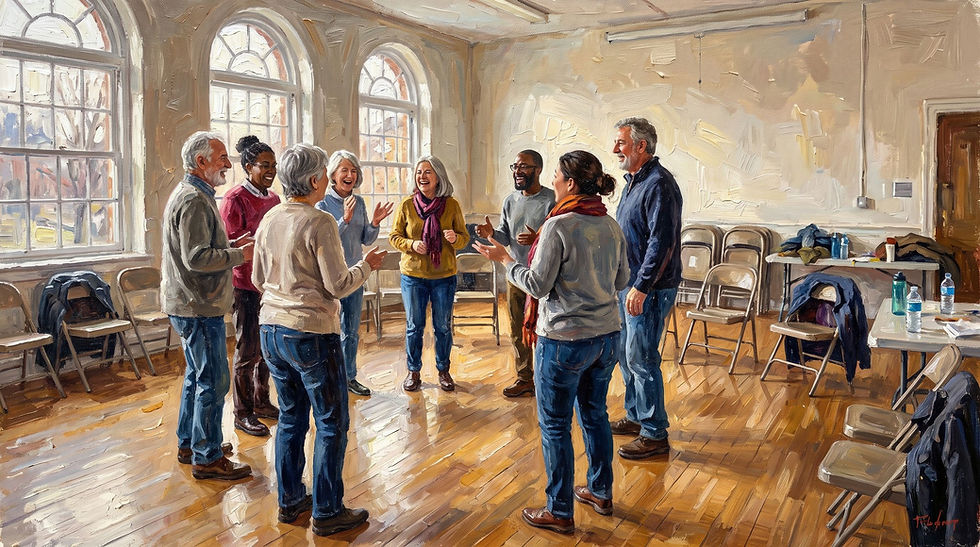
Here's something I've noticed teaching improv workshops, people can do beautiful two-person scenes all day but put five of them on stage together and suddenly it's a traffic jam. We spend so much time on duos that group scenes become this mysterious thing nobody quite taught us how to handle. The truth is they work differently and once you get the hang of them they're some of the most fun you can have on stage.
The single most useful thing I can tell you about group scenes is this, you only need two main points of view. That's it. Two perspectives driving the whole thing. You could have six people on stage and still only need two opinions in the room.
The Penguin Principle
I saw this demonstrated beautifully in a workshop a few years back. A group of players came up as penguins arriving at a movie theater to watch "Happy Feet" and the box office vendor would not let them in. That whole scene ran on two points of view. The vendor had one opinion, no penguins in the theater, and every single penguin had the opposite opinion, we want to see this movie. Did the penguins all have different reasons they wanted to see it? Absolutely. One penguin saved up for weeks. Another just really loved that one song. That's not the same point of view though.
Different reasons are fine. A different opinion is what breaks the scene.
This is the distinction that matters. You want different textures and motivations within each side, not a third or fourth side splitting the focus. When I teach this I tell my students to think of it like a tug of war. Two sides pulling is a game. Three sides pulling is a tangle.
The Quiet Superpower
The thing about group scenes is you spend a lot more time listening than talking. In a two-person scene you're half the airtime roughly. In a six-person scene you might talk a sixth of the time and listen for five sixths. That's a huge shift and a lot of improvisers find it uncomfortable at first.
But here's the reframe I like to offer. That listening time isn't waiting time, it's gathering time. You are watching, absorbing, finding where you fit. The best group scene players I know are the ones who seem almost quiet until they drop in with exactly the right reaction at exactly the right moment. They spend most of the scene listening and then they say one thing that shifts everything.
Bring a Reaction, Not a Scene
When you walk into a group scene you don't need to bring much. You need a reason you hold the point of view you hold and a reaction to anyone who holds the opposite one. That's really it. If you're on the penguin side of things you don't need to invent the whole ticket-buying process. You just need to be a penguin who really really wants to see Happy Feet and is frustrated that this person won't let you in.
The less you carry into a group scene the more room you have to react to what's already there. That's where the good stuff lives.
Be Willing to Follow
This one hurts sometimes because everybody wants to be the person with the cool idea. But if six people all bring their own cool idea you don't have a scene, you have a pitch meeting. If someone has labeled you as part of a group of people who want to overthrow the head of the local gardening club your job is to find a good reason you want to do that, not to ask "do we really want to?" because that pulls the scene into negotiation and prevarication and that is the death of momentum.
Jump on board. Find your reason. Add fuel.
That's how a group scene catches fire in the good way.
What This Looks Like in Real Life
Here's why I love teaching this concept. Walk into almost any team meeting and you'll see the same dynamic. Everyone shows up with their own agenda, their own preferred outcome, their own hill to die on. That's a group scene with six points of view and it feels exactly the way a messy improv scene feels. Exhausting. Unfocused. Nobody knows what the scene is about.
Now imagine that same meeting with two clear camps. Team A thinks we should launch the product in March. Team B thinks we should wait until June. Suddenly the conversation has shape. People within each camp can contribute different reasons for their position and the whole thing builds toward something. A team with two opinions debates. A team with six opinions wanders.

The next time you walk into a meeting ask yourself what the two sides really are and if they're both clear to everyone in the room. If they're not, start there. Name the two points of view and suddenly everybody knows what scene they're in.
The Bottom Line
Group scenes get a bad reputation as chaos magnets but they don't have to be. Two points of view, a willingness to listen more than you talk, a light grip on your own ideas, and a readiness to follow someone else's lead. That's the whole recipe. It works on stage and it works in the conference room.
The best group scenes and the best meetings feel the same way. Everybody knows what they're doing there and they're all pulling in the same two directions.


Comments