

There Is No One Way to Improv

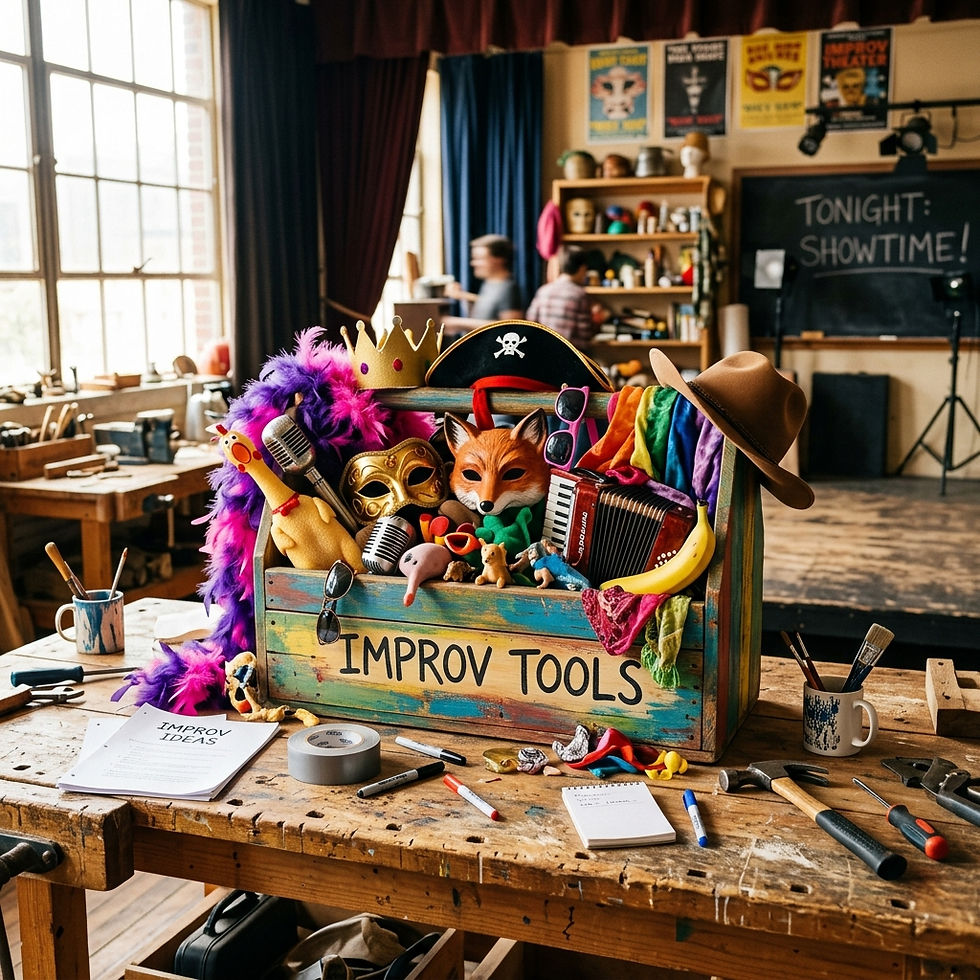
A few days ago, Lloydie over at Improv Chronicle published a piece called "When Dogma Dies, Improv Comes Alive." It's a good read. The central idea is that an informed point of view is worth more than one you inherited just because it's the only school you've ever known. And the pool metaphor stuck with me: you can't see the water you've been swimming in until you get out.
I read it and nodded along. But the more I sat with it, the more I realized the real takeaway isn't just about being informed. It's about something simpler and more universal.
There is no one way to improv.
Each school, each teacher, each tradition offers another tool for the toolbox. Some of those tools will fit your hand and some won't, and that's not a failure. Not of the tool and not of you. It's just the shape of learning.
My Improv Education
I didn't train at one of the big-name schools with a decades-long legacy and a brand that travels. My training is local. I cut my teeth at Just the Funny in Miami, found my rhythm at Villain Theater, and picked up pieces from workshop after workshop at festival after festival.
That wasn't a plan. It's just what was available, and honestly, it might be the best thing that could've happened to my improv.
When you learn from one school, you learn one philosophy deeply, and that's valuable. It gives you fluency in a style, a shared vocabulary with other improvisers from that tradition, and a clear framework for making scenes work. But it can also give you something else: the quiet assumption that your way is the way.
I never had that luxury or that trap. Every festival workshop was a reminder that there's another way to approach a scene, think about status, find the game, or be honest and weird at the same time. Some of those approaches became permanent additions to my toolkit and others didn't, but even the ones I didn't keep taught me something about what I actually believe.
Schools Are Toolboxes, Not Religions
The trap is treating a school's philosophy like a doctrine. You start defending it instead of using it, and you start measuring scenes by whether they followed the rules instead of whether they worked. But improv isn't a faith. It's a practice, and a practice is something you build.

The UCB approach gives you game and structure. iO gives you emotional truth and follow the follower. The Annoyance gives you permission to be weird. Johnstone's work gives you status dynamics and spontaneity. Just the Funny and Villain Theater gave me stage time, community, and the freedom to figure out what I think.
None of these is the way. Each is a way. And the work of becoming an improviser isn't picking which one is right. It's figuring out which tools serve you and what scenes you want to build with them.
The Universal Lesson
This isn't just about scene work. It applies to teaching, leadership, building systems, running a business, or serving in Rotary. Everywhere people gather around a discipline, the same pattern emerges: someone finds a method that works, it gets codified, it gets taught as the way, and eventually people mistake the method for the mission.
The best teachers I've had weren't the ones who told me the one right way to do something. They showed me their way, then pointed at the door and said, "Now go find yours."
The best leaders I've seen don't enforce a single philosophy. They build a culture where people can find the tools that work for them and bring those tools back to the group. And the best systems aren't the ones that eliminate all variation. They create room for different approaches within a shared purpose.
So What Now?
Keep exploring. Keep showing up to the workshop. Keep reading the newsletter from someone whose tradition is different from yours. Keep asking yourself if this tool fits your hand.
The goal isn't to collect every tool. It's to know which ones are yours.
Because in the end, your path is your own. No school can walk it for you. But the right tools, the ones that actually fit, can make the walk a lot more interesting.


Comments